Notes / Workers
When Should Your Business Use an AI Voice Agent?
A practical framework for deciding whether an AI voice agent should handle more inbound calls—and how to run it as a managed Worker.
By Rich Hill III. Published Aug 7, 2026. 10 min read.
An AI voice agent is worth considering when it can turn a repeatable inbound call into a safe, observable next step. That is a narrower job than “handle the phones,” and it is the difference between useful capacity and a frustrating caller experience.
The right first deployment is usually not a synthetic receptionist asked to impersonate a human or improvise through every situation. It is a managed call-handling Worker with a defined mission: capture an approved intake, answer a bounded set of questions, route to the right queue, offer a permitted appointment slot, or create a clean callback request. It should know what it may do, what it must not do, and how to hand a caller to a person.
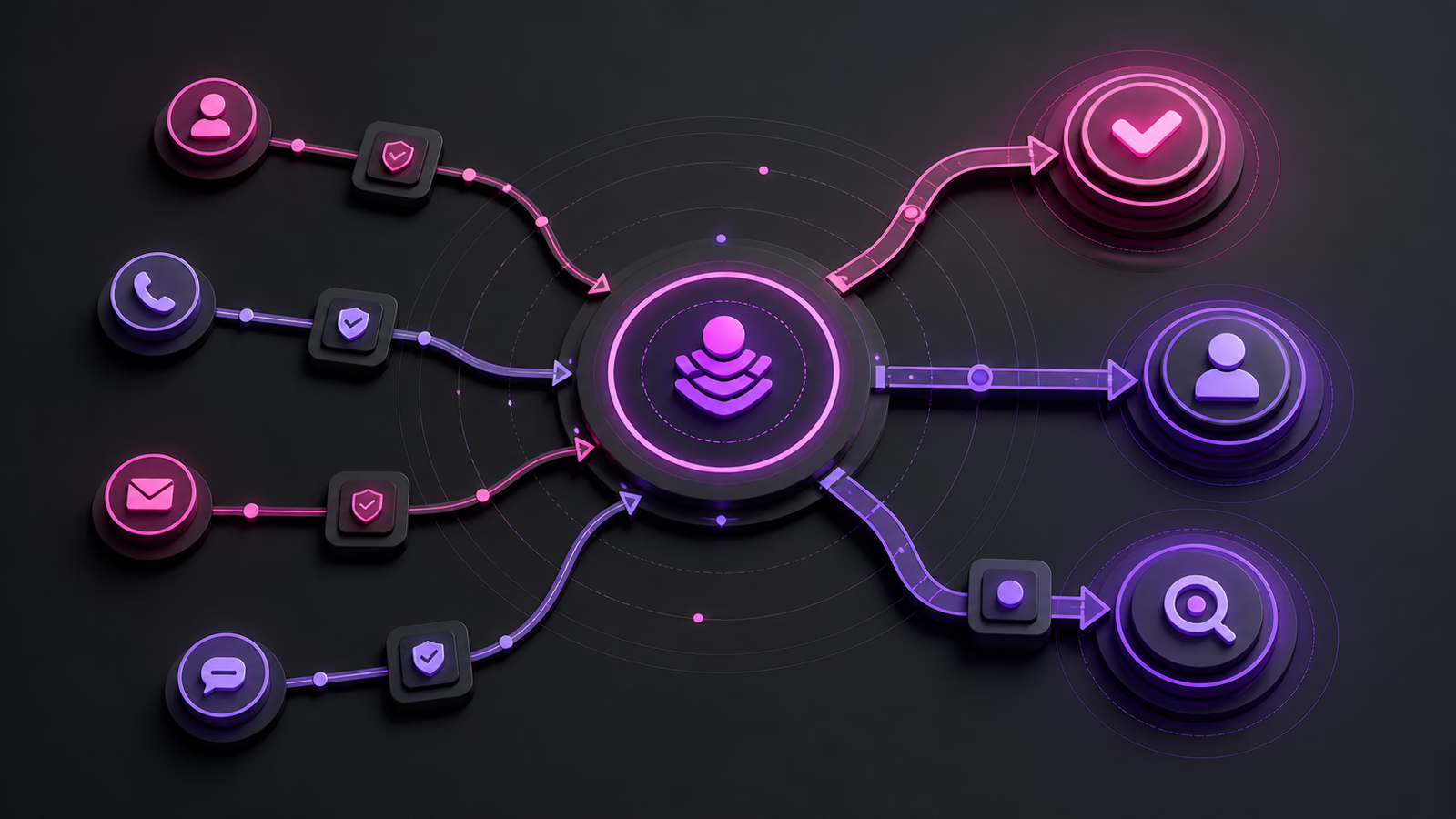
At the system level, voice AI can receive a call, understand the stated need, retrieve approved business context, use narrowly permitted tools, route or schedule a next step, and leave a reviewable record for the team. That is a sound solution when those capabilities are assembled around one controlled call path. It is not sound merely because the voice is natural: the business still has to define the mission, source of truth, permitted actions, escalation rules, and owner.
That framing matters because more answered calls are not automatically better calls. A business can eliminate voicemail and still lose trust if callers get trapped in loops, receive an answer outside policy, or cannot reach a person when the situation changes. NIST’s Generative AI Profile emphasizes defining supported tasks, documenting knowledge limits and human oversight, and evaluating outputs against known examples. Those are practical operating requirements for voice, not paperwork around it.
The question is not “Can a voice agent talk?” It can. The question is whether a particular call can safely become a repeatable workflow.
What is the right use for an AI voice agent?
Use AI voice when the call’s next step is clear enough to define before the call arrives. For many service businesses, that can mean overflow and after-hours intake, appointment requests, service-area checks, hours and location, order or status questions drawn from approved systems, or routing a caller to the appropriate team.
A useful test is simple: could a capable new team member follow a short, reviewed playbook for this call type without making a consequential judgment? If yes, the call may be a good candidate for a Worker. If the answer depends on nuanced judgment, undocumented policy, a disputed history, or an exception that changes the customer’s rights or safety, start with a human-led path instead.
Frequently asked questions
Can an AI voice agent replace my receptionist?
Not as a blanket decision. It can own a defined, repeatable part of the call flow, such as overflow intake, approved FAQs, routing, or limited scheduling. Human staff remain necessary wherever judgment, discretion, relationship management, high-stakes decisions, or exceptions matter.
Should I use AI voice only after hours?
After-hours or overflow coverage is often a sensible first pilot because the mission can be narrow and reviewable. It is not the only option. The better criterion is whether the call type has clear rules, safe actions, a human recovery path, and an owner who will review the results.
Does an AI voice agent need to tell callers it is AI?
The applicable answer depends on the jurisdiction, industry, exact script, recording practice, and call flow. Do not assume one universal rule. Review the deployment with qualified counsel or a compliance owner, and keep identity and purpose clear rather than using deceptive impersonation.
What should an AI voice agent never do?
Do not give it authority to make legally consequential commitments, change payments or accounts, improvise a clinical or safety judgment, settle a complaint, or handle other high-consequence actions without an appropriately designed human review path. The exact boundary should be written for the business, not inferred from a generic prompt.
What is the first metric that matters?
Start with whether the Worker produces the intended, reviewable next step: a complete intake, correct route, permitted booking, or useful escalation. Pair that with review of caller confusion, corrections, and edge cases. A high answer rate alone is not success.
Explore Workers