Notes / Workers
Where Does Your Data Go When an AI Worker Does the Work?
Follow one business document through an AI Worker and learn how to map its sources, recipients, artifacts, access, retention, deletion, evidence, and owners.
By Rich Hill III. Published Sep 10, 2026. 12 min read.
Start with one ordinary document.
A customer sends an attachment to an approved inbox. An AI Worker recognizes the request, reads the fields needed for its assigned job, checks the relevant business record, and sends purpose-scoped context to an approved model endpoint. It prepares a proposed update and a response. If the workflow calls for review, the work pauses for a person. Once approved, the Worker updates the connected system and records what happened.
The document did not sit in one place. It moved through a defined operating path.
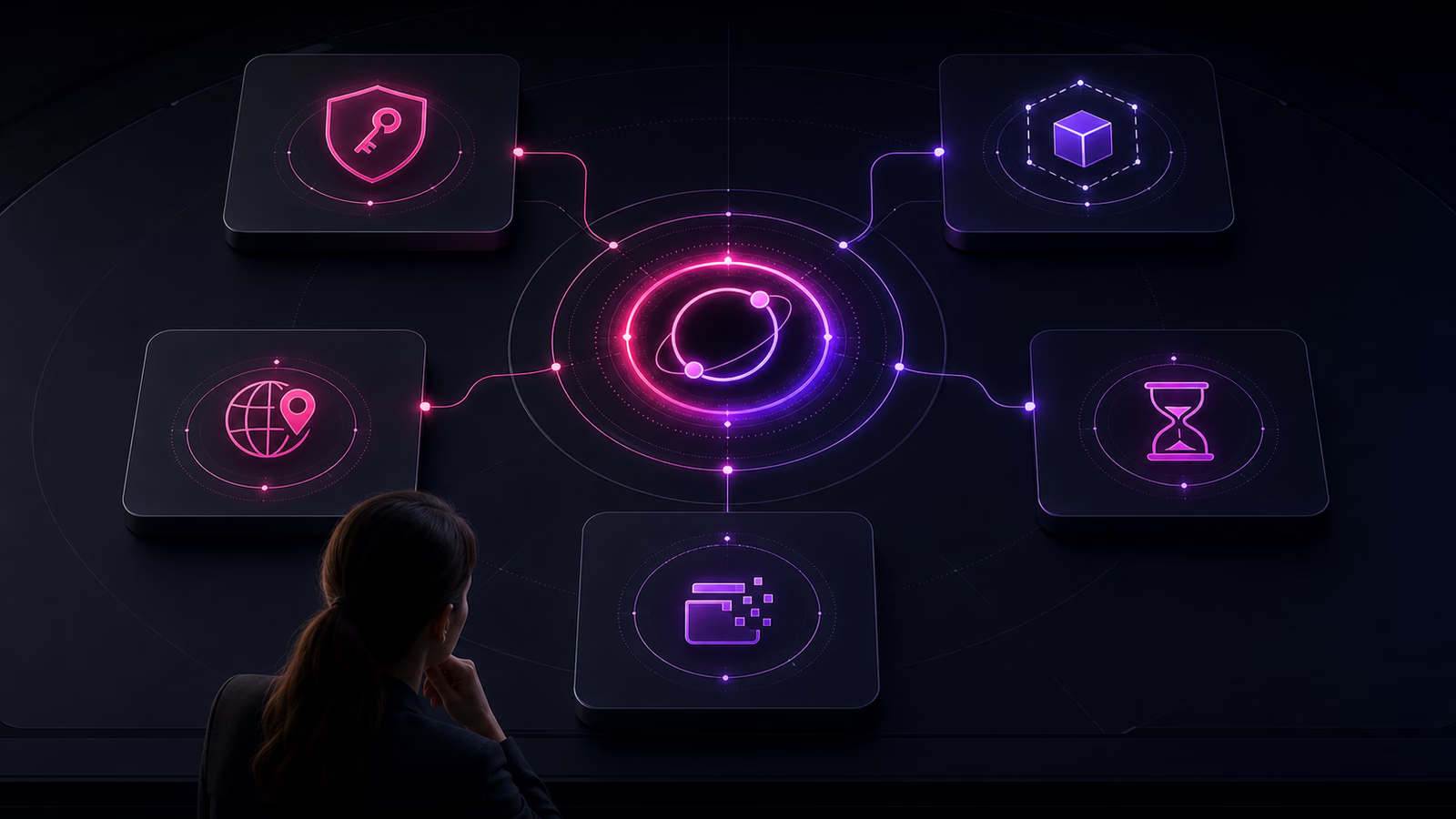
The direct answer: An AI Worker’s data may pass through source systems, its runtime, model endpoints, connected tools, working state, human review, audit records, and retention or deletion systems. A trustworthy answer maps what is read, sent, created, stored, shared, retained, and deleted; where each step occurs; who can access it; and who owns each control.
That map is what turns an abstract data question into an operating decision.
A deployment needs precise answers for the Worker’s role, connected responsibilities, tools, permissions, and business context. That is why Workers maps information handling, approval points, and human ownership across the agreed responsibilities and workflows.
Where does data go during an AI Worker workflow?
Data follows the work.
Frequently asked questions
Is an enterprise AI plan automatically safe for confidential data?
Enterprise controls can be valuable, but the exact product, endpoint, agreement, region, retention settings, support access, tools, and approved use case still determine the data path. Treat the plan as one layer of the deployment review.
Is using an AI Worker the same as sharing data with a third party?
Whenever an external model provider or connected tool receives information, that recipient becomes part of the data path. That does not make the workflow unsuitable; it means the purpose, access, agreement, retention, and deletion terms belong in the lifecycle map.
Can an AI Worker keep company data entirely inside one environment?
Sometimes. The relevant boundary must include the model endpoint, connected tools, observability, update and support paths, and any cross-region processing—not only the Worker runtime. The final answer depends on the chosen architecture and contract.
When should an AI Worker’s lifecycle map be reviewed again?
Review it whenever a source scope, model, endpoint, tool, region, logging rule, retention setting, support path, approval, or owner changes. A periodic check should also confirm that the documented path still matches the operating workflow.
Does removing names make information safe to send to an AI model?
Not necessarily. Context and combined fields can still reveal a person or expose confidential business information. The stronger rule is to send only the approved information necessary for the task and evaluate whether the remaining context is still sensitive.
Explore Workers