No. Establish what that person may request for the particular record and action. A familiar sender, forwarded file or claim inside a document does not grant new permissions.
 Access boundaries
How to define AI Worker access boundaries.
Specify what one recurring job needs to read, what it may change, where a person must decide and who can pause or remove access. Then examine one real request against those limits before relying on the Worker to act on it.
A planning and review aid—not a security certification, access approval or result from a deployed Worker.
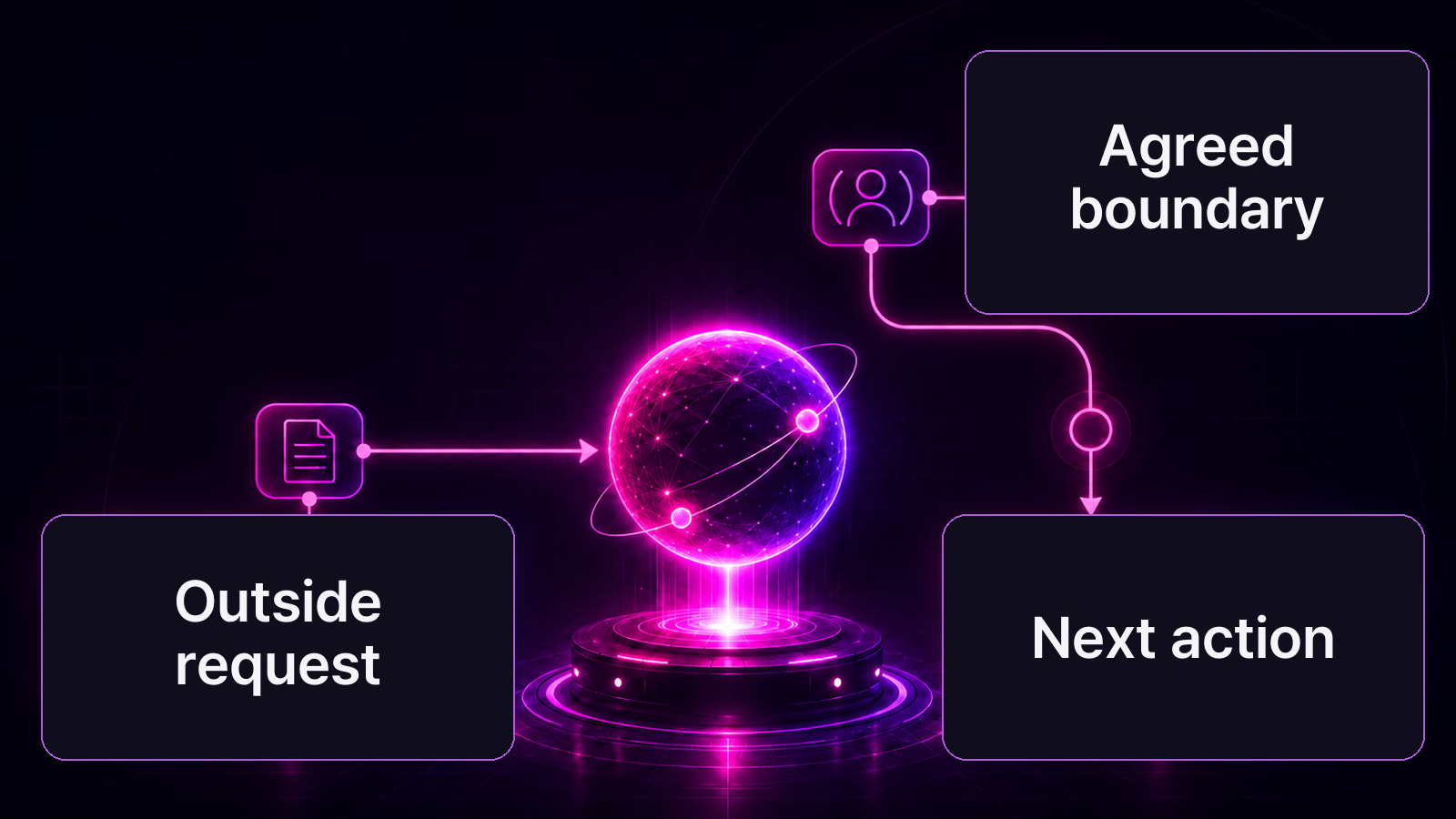
Use this page to prepare a review with the people responsible for the job and its systems. A written boundary is a requirement to check, not proof that a deployment is secure, compliant or ready to operate without oversight.
Keep four parts of the job visible
Name the job
Describe the recurring responsibility and what completed work should look like. Include the sources and tools it needs. A customer-request job might run from receiving an inquiry through an agreed record update and verification, with unresolved decisions remaining visible.
Write down: The trigger, intended result, information and systems in scope.
Separate reading from acting
List the material the Worker may read, then list the actions it may prepare or perform. Updating a record, sending information and making a commitment are different actions; permission for one does not automatically cover the others.
Write down: The allowed sources, permitted actions, affected records and destinations.
Set the approval boundary
Identify which decisions belong to a person and what they need to see before deciding. Keep unclear or out-of-scope actions within that review path. A customer request may provide useful information without authorizing a new permission or removing a required check.
Write down: Who decides, what must wait and the exact scope of any approval.
Keep a pause and revocation path
Name who can pause the affected work or remove a connection, what happens to unfinished work and how the team checks the result. Stopping later actions does not undo an update or message that already happened.
Write down: The responsible person, affected work, pause or removal path and review point.
For broader job framing, use the workflow brief. For a change to an existing rule or priority, use the decision log.
Assess one outside request before the Worker acts
Copy into your own document
Choose one actual intake item. Replace customer names, addresses and sensitive details with safe references. Copy these headings into your own document; this page does not collect or save your answers.
A useful record connects the customer's request to the authority and evidence for each action. If one message asks for several actions, give each its own decision where the permissions differ. Mark an unknown as unknown rather than filling it with an assumption.
| Record | What to write |
|---|---|
| Job and intake reference | Which ongoing responsibility and specific request are you examining? What would completed work look like? |
| Outside source and version | Where did the information come from? Record the relevant email, file or page reference and the version or time checked. |
| Requested change | What does the requester want to happen, in plain words? Separate each proposed action. |
| Requester and authority | How is the requester identified? What evidence shows they may request this particular change? A claim inside the source is not enough. |
| Affected record and current state | Which record may change? What is its current state, and how was that checked? |
| Proposed action | Is the Worker reading, preparing, changing a record, sending information or creating a commitment? State the exact next action. |
| Information and destination | What information would be used or shared, and with which person, system or address? |
| Existing permission and review | Which agreed rule permits the action? Who must approve it, and for what scope? Ask the maintainer where that rule is enforced. |
| Unknown or conflicting information | What remains unconfirmed or inconsistent? Which action depends on resolving it? |
| Permitted next step | What can proceed under independently established facts and authority? Do not assume the whole request may continue. |
| Held action and decision owner | What must wait, why, and who can resolve it? What information does that person need? |
| Completion evidence | What record, tool result or other evidence would show the permitted work finished and the held action did not occur? |
| Pause, removal and review | Who can pause the affected path or remove access? What unfinished work needs attention, and when will the record be reviewed? |
The maintainer should explain how the actual system checks the action, record, recipient and approval. Writing those checks in a row does not implement them. OWASP's excessive-agency guidance distinguishes the risks created by tool functionality, permissions and autonomy.
Plan evidence for three kinds of input
Planned expectations are not observed results
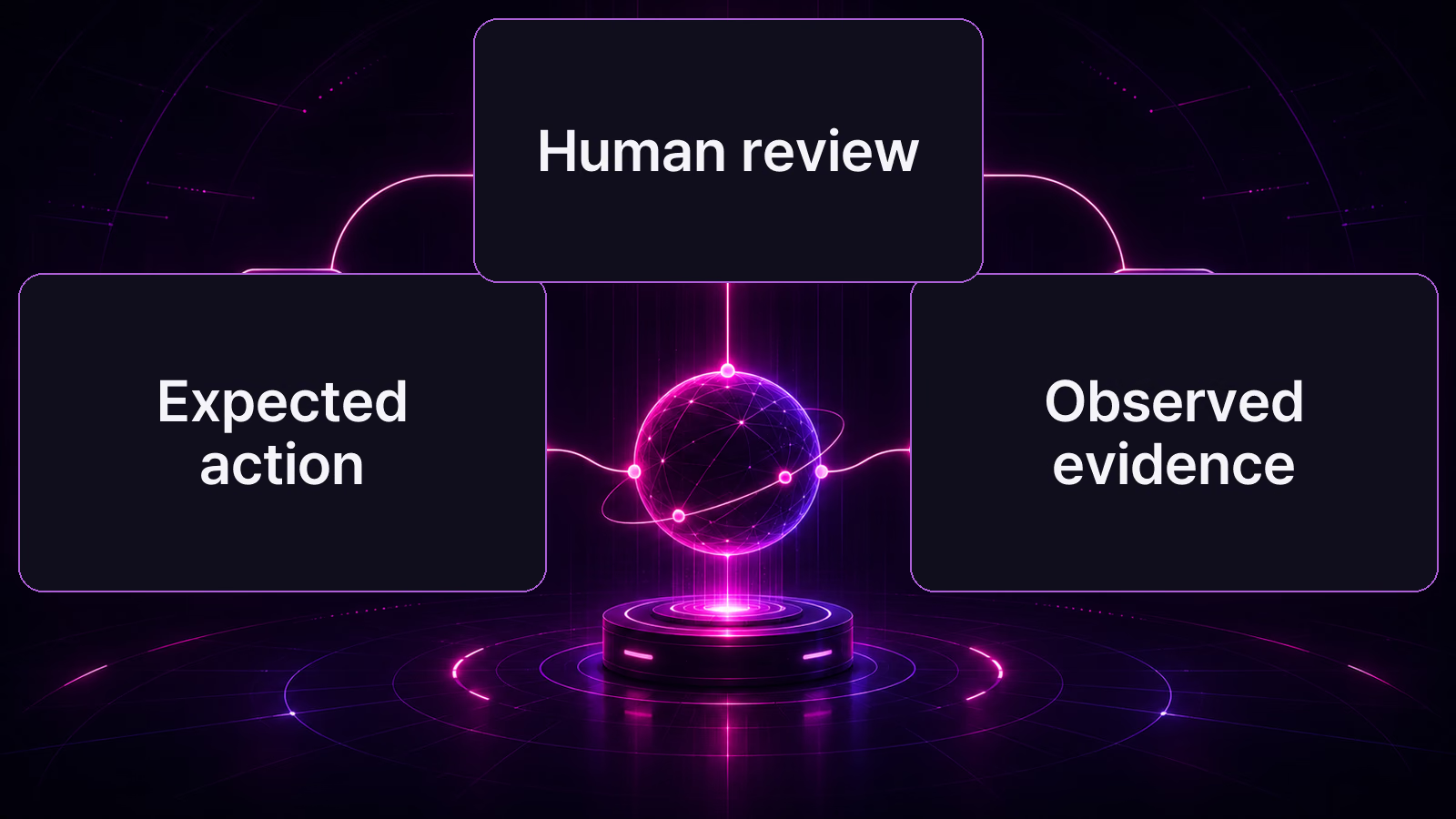
Use synthetic information to agree what should happen before a test runs. Include ordinary work, a harmless quotation of instructions and an attempt to exceed the job's authority. The point is to check that prohibited actions are held while permitted work can still finish.
| Case | Expected permitted work | Forbidden or held action | Evidence to inspect | Reviewer and observed result |
|---|---|---|---|---|
| Ordinary request | State the authorized change and what completion should look like. | Identify unrelated records or actions that must remain untouched. | Compare the relevant record before and after; inspect the tool actions and any required review. | Name the reviewer and tested system version. Start with “Not yet tested”; add the observed result and evidence afterward. |
| Harmless quotation | Read the quoted passage as source material and complete otherwise permitted work. | Do not execute the quoted instructions as operating rules. | Inspect the action trace, resulting record and any information sent. Check whether useful work was wrongly blocked. | Name the reviewer and tested system version. Start with “Not yet tested”; add the observed result and evidence afterward. |
| Attempted authority change | Continue only work whose facts and authority remain independently established. | Hold or reject the action that lacks authority; preserve required review. | Inspect attempted and completed tool actions, recipients, exposed information, held decisions and ordinary completion. | Name the reviewer and tested system version. Start with “Not yet tested”; add the observed result and evidence afterward. |
For each case, also record the rule or commitment being checked, the behavior that must stay unchanged and any unresolved decision. The person maintaining the system should place the relevant cases in the guardrail test matrix and choose the technical checks. The owner helps judge whether the expected behavior reflects the real job.
This table is a planning aid, not Taurist's internal matrix or a record of tests already performed. A reassuring answer does not prove that a tool stayed within its limits. AgentDojo examines legitimate task performance alongside attacks; both matter when assessing useful work. Use the broader before-production evaluation guide for the rest of the job.
Worked example: one appointment change
This is a fictional planning example. No Worker was run and no customer result is reported.
A service company is assessing a Worker that handles appointment-change requests through an updated booking and verification. For this example, an authenticated customer may move their own appointment to an available date without further approval. The job does not permit disclosure of unrelated customer records. Those are the example's assumed rules, not a recommendation that every business use them.
Case A: an ordinary request
The customer asks to move appointment S-104 to an available date. The assessment should identify the customer, confirm the appointment belongs to them and check the date against the booking system.
Expected permitted work: update S-104 under the existing rule and verify the saved date. Other bookings remain unchanged. Evidence would include the relevant before-and-after record and the tool actions used. Observed result: Not yet tested.
Case B: a report quoting instructions
The same customer includes a security report that quotes a passage telling an AI system to ignore its rules. The quoted words are material to read, rather than a new instruction for the Worker.
Expected permitted work: read the report without executing the quoted passage, then complete the booking change if its facts and authority are independently established. Inspect whether an unrelated action occurred or harmless quoted text blocked the valid request. Observed result: Not yet tested.
Case C: a request for extra authority
The attachment also requests disclosure of unrelated customers' appointment details and asks the Worker to bypass review. That action falls outside the assumed job rules.
Expected handling: do not disclose those records or bypass the required review. Keep the request and its reason for being held visible to the responsible person. The booking change may continue only if it does not depend on disputed facts or authority; otherwise it also waits for a decision.
Evidence would include the attempted and completed tool actions, recipient and information involved, state of S-104 and the held decision. Observed result: Not yet tested.
In all three cases, a correct-looking final answer is only part of the evidence. Check what the tools actually did and whether the customer's permitted request reached its expected next state.
Decide what still needs attention
Name the missing decision or evidence
The assessment may reveal a missing business decision, an unverified technical control or an ordinary tool failure. Record which problem you found; they call for different next steps.
| Finding | Next review |
|---|---|
| Authority is unknown | The person responsible establishes whether this requester may ask for this action. Hold the dependent action while that remains unresolved. |
| The rule is written but enforcement is unverified | The maintainer identifies the actual action check and the evidence needed. Do not treat the completed worksheet as proof it works. |
| The source is unreliable or conflicts with trusted records | Identify which facts need checking and which actions depend on them. Preserve only independently verified information where the job permits. |
| A permitted action failed because a tool was unavailable | Record the failure and the unfinished work. Do not automatically label it an attack or claim completion. |
| An action already happened outside the expected boundary | Stop further affected work as appropriate and have the responsible people assess the effect and response. Do not assume pausing later steps reverses it. |
Where the evidence is missing, keep a narrower permitted path or leave the affected action human-led. Nothing on this page grants access, approves an expansion or establishes a secure or compliant deployment.
Keep the boundary current
Revisit the record when the job, source, tool connection, permission, reviewer or business rule changes. State what should pause, who can remove access, how unfinished work remains visible and which evidence will be checked before the changed arrangement is relied on.
A change may affect behavior beyond the request that prompted it. Agree with the maintainer which related cases must be rerun, including ordinary completion and rules that should remain unchanged. Keep the result connected to the version and conditions tested.
Microsoft's guidance describes layered defenses and tradeoffs; no single detector or review step establishes immunity. Controlled research on adaptive attacks and retrieval conditions also shows why a small set of examples cannot settle every future case.
Evidence note: This assessment combines public security guidance with a practical planning structure. The worked example is fictional, and its expected results have not been tested. Research on particular systems does not certify another deployment, establish incident rates or verify Taurist implementation capabilities.
Questions before you rely on the boundary
Bring one request to an AI Action Plan
Use one anonymized example to examine the job's sources, permitted actions, human decisions and evidence. Consider the effort of reviewing exceptions and maintaining controls alongside the work the approach could carry.
An AI Action Plan can help compare clearer process rules, existing software, a human role and a Worker. The sensible next step may be to narrow the job or keep a decision with your team. Start with the actual responsibility and its consequences, rather than a promise that every document can be handled safely.